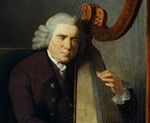
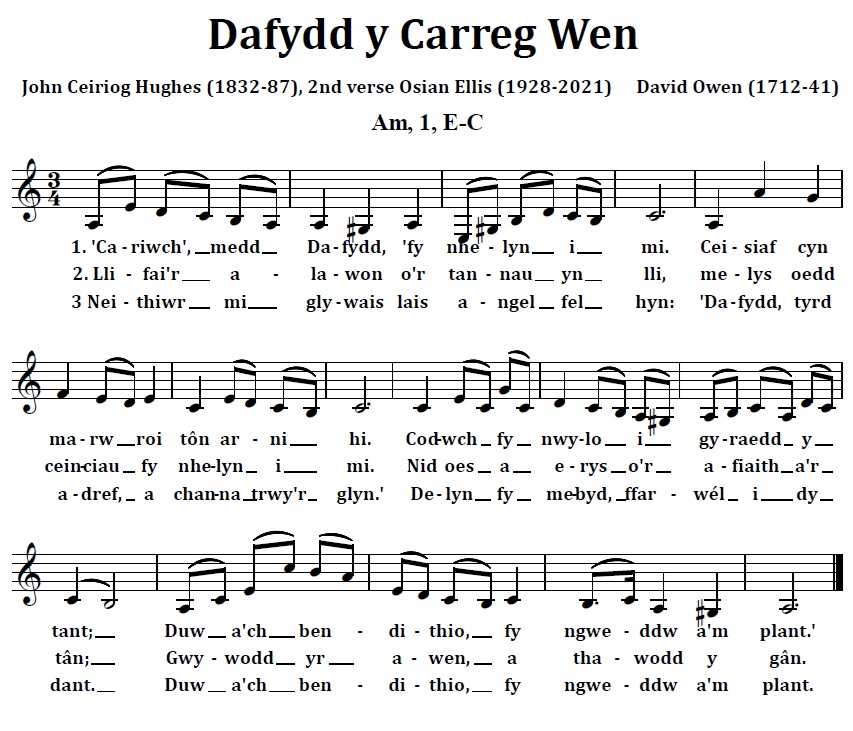
'Dafydd y Garreg Wen' (David of the White Rock) is a classic Welsh folk song centered on a dying harpist's final wish. It is based on the life of David Owen (1711-1741), a real harpist from Garreg Wen farm near Morfa Bychan, Porthmadog. According to tradition, as Owen lay dying at only 29, he woke from unconsciousness and claimed to have heard a heavenly melody. He called for his harp to play the tune one last time, expiring just as he struck the final note. The lyrics, added nearly a century later by poet John Ceiriog Hughes, reflect this scene of spiritual transition. The narrator bids a melancholy farewell to his family and his "faithful harp", interpreting his impending death as an invitation from an angel to "come home" and play in heaven. In 1923, this became the first Welsh-language song ever broadcast on the radio. The harpist Osian Ellis (1928-2021) is credited with adding an extra (second) verse to the song, which was performed in an arrangement by Benjamin Britten.
Lyrics
1. "Cariwch", medd Dafydd, "fy nhelyn i mi,	"Carry", said David, "my harp to me
Ceisiaf cyn marw roi tôn arni hi;		I would like before dying to give a tune on it;
Codwch fy nwylo i gyrraedd y tant;		Lift my hands to reach the string
Duw a'ch bendithio, fy ngweddw a'm plant!"	God bless you, my widow and children!"

2. Llifai'r alawon o'r tannau yn lli,		The tunes flowed from the strings in a stream,
Melys oedd ceinciau fy nhelyn i mi.		Sweet were the strains of my harp to me.
Nid oes a erys o'r afiaith a'r tân;		There is nothing left of the exuberance and the fire;
Gwywodd yr awen, a thawodd y gân.		The muse faded, and the song fell silent.

3. Neithiwr mi glywais lais angel fel hyn:	Last night I heard an angel's voice like this:
"Dafydd, tyrd adref, a chwarae trwy'r glyn."	"David, come home and play through the gloom!"
"Delyn fy mebyd! ffarwél i dy dant.		"Harp of my youth, farewell to your strings!
Duw a'ch bendithio, fy ngweddw a'm plant."	God bless you, my widow and children!"
Variations
Some versions use 'channa' (also meaning 'play' of an instrument) instead of 'chwarae' in the third verse. This is a stylistic variation used in Britten's version, but was not used by Ceiriog.
Recordings
Bryn Terfel sang verses 1 & 3 with harp accompaniment on his album 'We'll Keep a Welcome' (2000)
The '2002 Band' performed verses 1 and 3 (and then repeats verse 1), with harp and guitar accompaniment in 2018
Cerys Matthews sang verses 1 and 3, with harp accompaniment for verse 3, on her album 'Tir' (2010).
Notes for Welsh learners
"Ceisiaf" is the first-person singular form of the verb ceisio (to try or to seek) in the present indicative or future tense in literary Welsh
"Duw a'ch bendithio" means 'may God bless you'; this construction is known as the optative subjunctive, to express a wish, prayer, or hope in literary Welsh: the verb 'bendithio' (to bless) has the same form in indicative and subjunctive tenses
"A'm plant" is a formal version of 'a fy mhlant'
"Erys" is the third-person singular form of the verb aros (to stay, wait, or remain) in the present indicative or future tense
Vocabulary
Tant String (m, tannau)
Gweddw widow (f, gweddwon)
Lli shortened form of 'llif', meaning stream, flow, or flood (m, llifoedd)